TVS Scan for Women: Why It Is Important, How It Helps and Why Choosing a Female Radiologist Matters
Some medical examinations are not easy to talk about. TVS is one of them. Yet, for many women, this small but important investigation can help doctors understand what is happening inside the pelvis and guide the next steps in their healthcare.
Disclaimer: This page is intended to support patient understanding and should not replace professional medical advice, diagnosis or treatment.
There is something we should talk about more openly.
Many women experience pelvic pain, irregular periods, unusual bleeding or discomfort that they cannot easily explain. Some are trying to understand why they are not conceiving. Others are in the early stages of pregnancy and are worried about whether everything is progressing normally.
They visit a gynaecologist, describe their symptoms and sometimes receive a recommendation for a TVS scan.
And then the questions begin.
What exactly is a TVS scan? Why has the doctor recommended it? Is it painful? Is it really necessary? Will it be uncomfortable? Can I have the examination performed by a female radiologist?
These are perfectly reasonable questions.
If you have been advised to undergo a TVS scan and are feeling uncertain, this article is for you. Let's understand the examination, its importance and why your comfort and privacy deserve attention throughout the process.
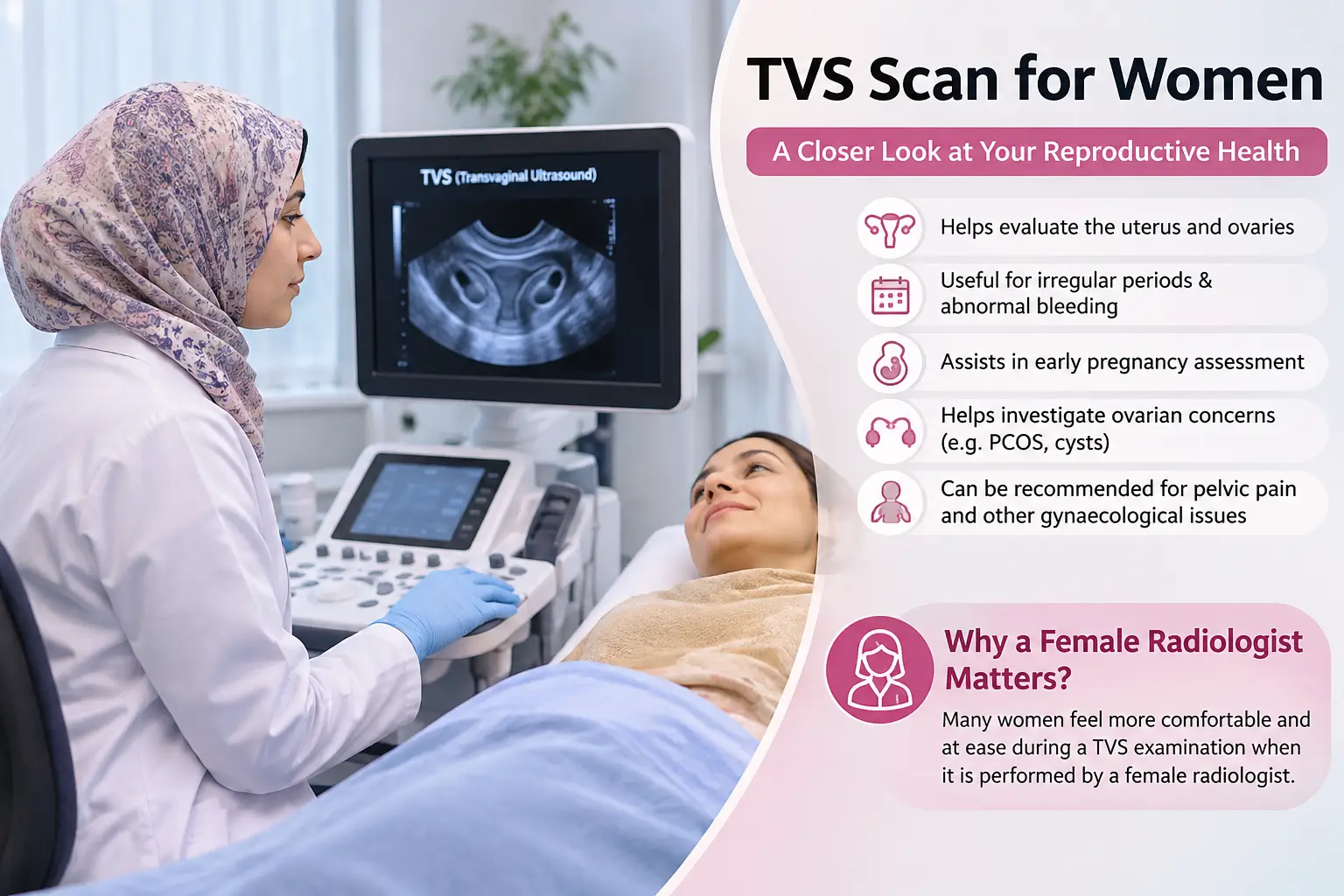
🌸 First, what exactly is a TVS scan?
TVS stands for Transvaginal Sonography, also commonly called a transvaginal ultrasound.
Unlike an ordinary abdominal ultrasound, where the doctor moves an ultrasound probe over your stomach, a TVS examination uses a specially designed, slim ultrasound probe that is gently introduced into the vagina.
You may wonder why a different approach is needed.
The reason is quite simple.
The uterus, ovaries and other pelvic structures are located inside the lower abdomen. When an ultrasound probe is placed closer to these organs, it can provide detailed images that may be difficult to obtain through an abdominal scan alone.
This helps the radiologist examine the pelvic organs more closely and identify findings that may be relevant to your symptoms.
The examination uses high-frequency sound waves. It does not use X-ray radiation.
TVS is not an unusual or experimental procedure. It is an established diagnostic technique used in gynaecological and early pregnancy imaging.
🔍 Why does a doctor recommend a TVS scan?
A TVS scan is not required for every woman. Your gynaecologist or treating doctor recommends it when the information it can provide may help with diagnosis or further management.
Here are some common situations in which it may be useful.
1. Irregular periods and abnormal uterine bleeding
Are your periods coming too early, too late or lasting longer than usual?
Have you noticed unusually heavy bleeding or spotting between periods?
There can be several reasons for these symptoms. A doctor may recommend TVS to examine the uterus and its lining, known as the endometrium.
The scan can help assess:
- The thickness and appearance of the uterine lining.
- The size and shape of the uterus.
- Possible uterine fibroids.
- Features that may suggest endometrial polyps.
- Other structural changes that may need further assessment.
It is important to remember that an ultrasound finding alone does not always establish the cause of bleeding. Your doctor may recommend additional tests depending on your age, symptoms and medical history.
2. PCOS and ovarian concerns
Polycystic ovary syndrome (PCOS) is a condition that can affect menstrual cycles, ovulation and hormonal health.
When clinically appropriate, pelvic ultrasound can help assess the ovaries and look for features associated with polycystic ovarian morphology.
TVS may provide detailed images of ovarian structures, including small follicles.
However, one important thing needs to be understood: PCOS cannot be diagnosed from an ultrasound image alone.
Your menstrual history, symptoms, examination and sometimes blood tests are also important. Not every woman with PCOS needs a TVS scan.
3. Pelvic pain and lower abdominal discomfort
Persistent pain in the lower abdomen or pelvic region should not simply be ignored.
Sometimes the cause is related to the reproductive organs, and a pelvic ultrasound may help the doctor investigate further.
TVS can provide useful information about:
- Ovarian cysts.
- Ovarian size and appearance.
- Uterine abnormalities.
- Certain pelvic masses.
- Features that may raise suspicion of conditions such as endometriosis.
The scan is one part of the investigation. Your doctor will interpret its findings alongside your symptoms and other clinical information.
4. Early pregnancy assessment
The early weeks of pregnancy can be filled with excitement, but they can also bring uncertainty.
A woman may experience spotting, pelvic discomfort or pain. Sometimes the doctor needs to establish where the pregnancy is located and assess early pregnancy development.
In appropriate situations, TVS can help identify early pregnancy structures and provide information about the pregnancy that may not be clearly visible through an abdominal scan.
It can be particularly useful when assessing:
- The location of an early pregnancy.
- The gestational sac.
- The yolk sac and embryo, when visible.
- Early cardiac activity, when appropriate for the stage of pregnancy.
- Findings that may require further assessment.
TVS can also help doctors investigate a possible ectopic pregnancy, where a pregnancy develops outside the uterus.
If you are pregnant and experience severe abdominal pain, fainting, shoulder-tip pain or heavy bleeding, seek urgent medical attention rather than waiting for a routine appointment.
5. Fertility investigations
For a woman who is trying to conceive, understanding the condition of the uterus and ovaries can be an important part of fertility assessment.
TVS may help evaluate:
- The uterus and endometrial lining.
- Ovarian size and follicular development.
- Certain ovarian cysts.
- Features relevant to ovulation monitoring.
- Some structural abnormalities of the reproductive organs.
Doctors may also use ultrasound during fertility treatment to monitor follicular development and assess the response to treatment.
For many women, these investigations are part of an emotional journey. They deserve patience, clear explanations and a respectful environment.
6. Assessment of the uterine lining after menopause
Even after periods have stopped, a woman may sometimes need a pelvic ultrasound.
For example, bleeding after menopause should always be medically assessed.
TVS can help measure and evaluate the endometrial lining and identify findings that may require additional investigation.
The scan does not replace further tests when these are needed, but it can provide valuable information to the treating doctor.
💙 How does TVS help compared with an abdominal ultrasound?
Both examinations are useful. Neither is automatically better for every patient.
The choice depends on the medical question, the patient's circumstances and the structures that need to be examined.
| Abdominal ultrasound | Transvaginal ultrasound |
|---|---|
| Probe is moved over the abdomen. | A slim probe is gently introduced into the vagina. |
| Often requires a full bladder for pelvic imaging. | Usually performed with an empty bladder. |
| Provides a broader overview of the pelvis. | Can provide more detailed views of nearby pelvic structures. |
| May be preferred when an internal examination is unsuitable or declined. | May be recommended when closer examination of the uterus and ovaries is needed. |
In some cases, the doctor may recommend both approaches to obtain a more complete assessment.
The important thing is not to choose a scan based on convenience alone. The appropriate examination should be decided according to your clinical needs.
🌷 Is a TVS scan painful?
This is probably one of the first questions many women want to ask.
The honest answer is that experiences differ.
For many women, TVS causes little discomfort. Some may feel pressure or mild discomfort when the probe is moved to obtain the required images.
Others may feel more anxious or uncomfortable, particularly if they have never undergone an internal examination before.
Your comfort should never be treated as an unimportant matter.
Before the examination, the healthcare professional should explain what will happen. A protective cover and suitable lubricant are used on the probe. The examination should be performed gently and with appropriate care.
If you experience pain, feel distressed or need a pause, tell the radiologist.
You should not feel pressured to tolerate an examination silently.
You can ask questions, request a pause or ask the examiner to stop. Your consent matters throughout the procedure.
👩⚕️ Why is choosing a female radiologist important for a TVS scan?
Now comes a question that deserves more attention.
Why do so many women enquire about female radiologists when booking an ultrasound appointment?
The answer is not difficult to understand.
A TVS scan is an intimate examination. It involves a sensitive part of the body, and the patient needs to feel comfortable with the person performing it.
For some women, the gender of the examining professional makes little difference. For others, having a female radiologist is a very important personal preference.
Neither preference should be judged.
Think about a young woman undergoing her first TVS examination. She may already be worried about the procedure. She may have questions that she finds difficult to express. She may feel embarrassed discussing intimate symptoms.
Knowing that a female radiologist is available may help her feel more relaxed and confident about attending the appointment.
The same may be true for a woman undergoing fertility investigations, someone experiencing pelvic pain, or a patient who has had an uncomfortable medical experience in the past.
A female radiologist may help some patients feel more at ease when discussing sensitive concerns and undergoing the examination.
This is not about questioning the professionalism of male radiologists. Skilled male professionals also perform these examinations with care and respect.
It is about recognising that a woman's comfort and personal preference deserve to be considered when arranging her healthcare.
Why female radiologist availability can make a difference
🌸 Greater personal comfort
Some women feel more comfortable undergoing an intimate examination with a female medical professional.
🌸 Confidence to discuss concerns
A patient may find it easier to discuss sensitive symptoms or ask questions when she feels comfortable with the person examining her.
🌸 Respect for personal and cultural preferences
Modesty, family circumstances and personal beliefs can influence a woman's choice of healthcare provider.
🌸 A more reassuring experience
When a patient feels listened to and respected, she may approach an unfamiliar examination with greater confidence.
🌸 A choice rather than a compromise
Women should have the opportunity to enquire about female radiologist availability instead of discovering only after arriving that their preference cannot be accommodated.
Of course, the presence of a female radiologist does not replace the need for informed consent, proper explanation, appropriate privacy and professional conduct. These responsibilities apply to every intimate examination.
💗 What should you know before going for a TVS scan?
If your doctor has recommended TVS, a little preparation can make your visit easier.
Here are a few things worth remembering.
1. Follow the instructions given by the diagnostic centre.
A TVS scan is generally performed with an empty bladder. If an abdominal scan is also planned, you may receive different preparation instructions.
2. Tell the radiologist about your concerns.
If this is your first TVS examination, or if you are anxious about it, let the healthcare professional know.
3. Mention relevant medical history.
Inform the radiologist about your symptoms, pregnancy status, previous pelvic surgery or any other relevant medical information.
4. Ask about female radiologist availability before visiting.
If you prefer a female radiologist, confirm the appointment and timing in advance.
5. Understand that consent is essential.
The procedure should be explained to you, and your permission should be obtained before proceeding. You can ask questions or change your mind.
6. Ask about a chaperone if you would feel more comfortable.
A chaperone or support person may be available according to the centre's policy and clinical arrangements. Ask before the examination if this is important to you.
7. Do not ignore significant symptoms.
If you have severe pelvic pain, heavy bleeding, fainting or other worrying symptoms, seek medical advice promptly.
🌿 What if a woman is unmarried or has never undergone an internal examination?
This is a concern that deserves a sensitive answer.
Some women worry about whether TVS is suitable for them, particularly if they have never been sexually active.
The decision should never be made through assumptions or embarrassment.
The doctor should consider the clinical indication, the patient's circumstances, her comfort and informed consent. If TVS is not appropriate or the patient does not wish to undergo it, alternative imaging approaches may be discussed.
An abdominal pelvic ultrasound or another suitable examination may sometimes provide useful information, although the level of detail can differ.
Please discuss your circumstances privately with your gynaecologist or radiologist. You do not need to feel embarrassed about asking.
💙 Female Radiologists at Orbit Diagnostics & Healthcare, Srinagar
At Orbit Diagnostics & Healthcare, we understand that women do not always approach ultrasound examinations with the same level of comfort.
For some, it is a routine pregnancy scan. For others, it may be their first experience of an intimate pelvic examination. Some women come with questions about fertility, irregular periods or persistent pain.
Whatever the reason, we believe every patient deserves to be treated with respect.
Orbit Diagnostics & Healthcare provides access to female radiologist services for women who prefer a female professional for their ultrasound examinations.
Our associated female radiologists include:
👩⚕️ Dr. Misba Manzoor Bhat
MD (Radiology)
👩⚕️ Dr. Sadaf Shahzad
MD (Radiology)
Our aim is to make women’s ultrasound services more accessible in Srinagar while giving importance to privacy, dignity and patient comfort.
We also understand that the experience does not depend on the radiologist alone. The support staff, examination room, communication and overall environment matter.
At Orbit, we aim to provide:
- Female radiologist availability for ultrasound examinations, subject to confirmed appointment schedules.
- Female staff support for women patients.
- A clean and hygienic ultrasound examination room.
- Respectful communication and attention to privacy.
- Clear guidance before and during the examination.
Whether you have been advised to undergo a pregnancy ultrasound, pelvic scan, TVS or another ultrasound examination, our team can help you enquire about the appropriate service and appointment.
Looking for female radiologists in Srinagar?
You can contact Orbit Diagnostics & Healthcare to check the availability of Dr. Misba Manzoor Bhat or Dr. Sadaf Shahzad before visiting.
🌸 A final word to every woman
If your doctor has advised you to undergo a TVS scan, please do not let embarrassment prevent you from understanding your health.
Ask why the examination is needed. Ask what it can show. Ask whether an abdominal scan would be sufficient or whether a TVS is recommended for a clearer assessment.
And if you feel more comfortable with a female radiologist, say so.
There is nothing unreasonable about that request.
Your health should never become a subject you are afraid to discuss. Your questions deserve answers, your concerns deserve attention, and your personal boundaries deserve respect.
A good diagnostic experience is not measured only by the images produced on an ultrasound screen.
It is also measured by whether the patient felt informed, comfortable and respected throughout the process.
At Orbit Diagnostics & Healthcare, we believe that women's healthcare should begin with understanding, continue with professional care and always respect a woman's dignity.
Because your health matters. And so does how you feel while taking care of it.