High Blood Pressure In Clinic
Some people consistently record higher blood pressure when visiting healthcare facilities. ABPM can help determine whether blood pressure remains elevated during everyday life.
Orbit Diagnostics & Healthcare offers one of the most affordable ABPM tests in Kashmir. The charge is only ₹950 for the first 24 hours. If monitoring is required beyond 24 hours, each additional day costs only ₹700.
Disclaimer: This page is intended to support patient understanding and should not replace professional medical advice, diagnosis or treatment.
Same-day appointments may be available depending on equipment availability and existing bookings. Please call before visiting.
If your doctor has advised an ABPM test, you probably have several questions before booking. Most patients want practical information first. They want to know how the monitor works, whether they can sleep with it, if fasting is required, how long it stays attached, when the report will be available and whether the test is uncomfortable.
At Orbit Diagnostics & Healthcare, Srinagar, ABPM (Ambulatory Blood Pressure Monitoring) is used to record blood pressure automatically over a 24-hour period while you continue your normal daily routine. Unlike a single blood pressure reading taken in a clinic, ABPM provides multiple readings throughout the day and night, helping doctors understand how blood pressure behaves during real-life activities and sleep.
This can be particularly useful when blood pressure readings vary from one visit to another, when hypertension treatment needs review, or when doctors want a clearer picture of your blood pressure outside the clinic environment.
Before scheduling an appointment, most people want quick and straightforward answers. Here are some of the questions we hear most often.
| Question | Quick Answer |
|---|---|
| Is ABPM painful? | No. You may feel the cuff tighten briefly during each reading, similar to a normal blood pressure check. |
| Can I sleep with the monitor? | Yes. The monitor is designed to continue recording while you sleep. |
| Do I need fasting? | No fasting is usually required. |
| Can I go to work? | In most cases, yes. Patients are encouraged to continue their normal routine. |
| Can I take my blood pressure medicines? | Usually yes, unless your doctor has advised otherwise. |
| How long does the test last? | Typically 24 hours. |
| Can I remove the monitor at night? | No. The device should remain attached for the full monitoring period. |
| Will the cuff inflate while sleeping? | Yes. Readings continue during the night, although patients usually adjust quickly. |
One of the most common questions patients ask is:
"My blood pressure was already checked in the clinic. Why do I need another test?"
A clinic blood pressure reading provides only a snapshot taken at one specific moment. Blood pressure can change throughout the day depending on physical activity, stress, sleep, medication timing and many other factors. ABPM helps doctors understand what happens over an entire day rather than relying on a single reading.
Some people consistently record higher blood pressure when visiting healthcare facilities. ABPM can help determine whether blood pressure remains elevated during everyday life.
If readings differ significantly from one visit to another, longer monitoring may provide a more accurate picture.
Doctors may use ABPM to assess how effectively blood pressure medications are working throughout the day and night.
Some individuals experience elevated blood pressure mainly during clinic visits due to anxiety or stress.
Night-time blood pressure patterns can sometimes provide important information that cannot be obtained during a routine clinic visit.
ABPM may be recommended when doctors need a more complete assessment of blood pressure control over a longer period.
It is completely normal to feel uncertain when a doctor recommends a new investigation. Many people worry that the monitor will be uncomfortable, interfere with sleep or restrict daily activities.
In reality, most patients continue their normal routine throughout the monitoring period. They go to work, spend time with family, attend appointments, watch television and sleep at home while the monitor quietly records blood pressure readings in the background.
The purpose of ABPM is not to make life more difficult for a day. The purpose is to gather information that a single blood pressure reading simply cannot provide.
ABPM stands for Ambulatory Blood Pressure Monitoring. While the name may sound technical, the concept is actually very simple.
Instead of measuring your blood pressure just once in a clinic, ABPM measures it repeatedly throughout the day and night while you continue your normal routine.
A blood pressure cuff is placed around your upper arm and connected to a small recording device that is usually worn around the waist or carried comfortably during daily activities.
The monitor automatically takes blood pressure readings at regular intervals over a 24-hour period. These readings are stored and later analysed to provide a much more complete picture of how your blood pressure behaves during everyday life.
For many patients, ABPM provides information that cannot be obtained from a single clinic reading. It helps doctors understand whether blood pressure remains consistently elevated, drops too low, rises during sleep or fluctuates significantly throughout the day.
Many patients wonder why a simple clinic reading is not enough. The answer lies in the amount of information collected.
| Feature | Clinic Blood Pressure Check | ABPM |
|---|---|---|
| Number Of Readings | One Or Two Readings | Many Readings Over 24 Hours |
| Measures During Daily Activities | No | Yes |
| Measures During Sleep | No | Yes |
| Detects Blood Pressure Fluctuations | Limited | Much Better |
| Identifies White Coat Hypertension | Difficult | Often Helpful |
| Assesses Medication Control Throughout The Day | Limited | Yes |
Most patients are pleasantly surprised by how simple the process is.
Your appointment begins with registration and a review of any relevant medical records or prescriptions you have brought with you.
A cuff is placed around your upper arm, similar to the one used during a routine blood pressure measurement.
The cuff is connected to a small portable monitor that stores blood pressure readings throughout the monitoring period.
You leave the clinic and continue your normal activities while the monitor automatically records blood pressure readings.
The monitor continues recording during the night, providing valuable information about sleeping blood pressure patterns.
After the monitoring period is complete, you return the equipment to the clinic.
All recorded readings are downloaded and analysed to create a detailed blood pressure report.
A report is prepared showing blood pressure trends, averages and patterns observed throughout the recording period.
This is probably the question patients ask most often before the appointment.
The sensation is very similar to having your blood pressure checked in a clinic. Every time the monitor takes a reading, the cuff briefly inflates around your arm and gently squeezes it for a short period.
The pressure lasts only a few moments before the cuff deflates automatically.
Some patients notice the cuff more during the first few readings, but most become accustomed to it quickly and continue their day without difficulty.
At night, the monitor continues recording. While a few patients notice the cuff inflating during sleep, many adjust surprisingly well and continue sleeping normally.
In most situations, yes. Doctors usually want to see what your blood pressure does during normal life rather than during a specially restricted day.
| Activity | Usually Allowed? | Notes |
|---|---|---|
| Walking | ✓ Yes | Normal daily walking is encouraged. |
| Office Work | ✓ Yes | Most office duties can continue normally. |
| College Or School | ✓ Yes | Normal attendance is usually possible. |
| Driving | ✓ Usually | Depends on symptoms and doctor's advice. |
| Sleeping | ✓ Yes | Monitoring continues throughout the night. |
| Using Mobile Phone | ✓ Yes | Normal use is usually fine. |
| Bathing | ✗ No | The monitor must remain dry. |
| Swimming | ✗ No | Water can damage the equipment. |
Comfortable clothing usually works best.
Loose-fitting shirts, sweaters, kurtas and tops generally make it easier to wear the blood pressure cuff comfortably throughout the day.
Many patients find that short sleeves or loose sleeves make the experience more convenient, especially when the cuff inflates automatically during readings.
There is usually no need to purchase special clothing. Most people simply wear their normal everyday clothes.
Most patients describe the sensation as similar to a normal blood pressure check.
Most people adapt quickly and continue sleeping reasonably well.
No. It only measures blood pressure and does not deliver electricity.
The equipment is generally discreet and can usually be concealed beneath clothing.
Yes. ABPM is commonly performed across a wide range of age groups.
Most normal daily travel can continue unless your doctor advises otherwise.
One of the first questions patients ask after receiving a referral for Ambulatory Blood Pressure Monitoring is:
"How much does an ABPM test cost?"
An Ambulatory Blood Pressure Monitoring (ABPM) test in Srinagar typically costs around ₹650 per session in Orbit Diagnostics & Healthcare Baghat, Barzulla Srinagar.
That is a perfectly reasonable question. Before scheduling any investigation, most people want to understand what the test involves, whether it is necessary and what the expected cost may be.
The cost of an ABPM test can vary depending on the healthcare facility, the monitoring equipment being used, reporting requirements and the level of analysis included in the final report.
Because pricing can change over time, patients are encouraged to contact the clinic directly for the latest charges and appointment availability.
Different facilities may use different monitoring systems and software platforms for recording and analysing blood pressure data.
ABPM generates dozens of blood pressure readings over a 24-hour period. These readings must be reviewed and analysed before a report can be prepared.
Some patients require more detailed review depending on their medical history, medications and blood pressure patterns.
Diagnostic centres, speciality clinics and hospitals may have different operational structures and pricing policies.
One reason patients appreciate ABPM is that preparation is usually very straightforward. Most people can continue their normal daily routine before the appointment.
No. ABPM usually does not require fasting and most patients can eat and drink normally.
Yes. Drinking water is normally allowed before and during monitoring.
Patients should generally continue medications exactly as prescribed unless advised differently by their treating doctor.
Do not stop prescribed medications without first discussing the matter with your doctor.
Bringing relevant documents helps provide useful clinical information and can assist with interpretation of the report.
| Item | Why It May Be Helpful |
|---|---|
| Doctor's Prescription | Provides information about the reason for monitoring. |
| Previous Blood Pressure Records | Allows comparison with earlier readings. |
| Medication List | Helps provide context regarding ongoing treatment. |
| ECG Reports | May provide additional information regarding cardiovascular health. |
| Echo Reports | Can provide supporting clinical information when available. |
| Relevant Medical Records | Useful if hypertension management is already ongoing. |
Many patients are surprised to learn that blood pressure can be higher in a clinic than it is during normal daily life.
Simply being in a medical environment can make some individuals feel anxious, even when they do not realise it. This temporary increase in stress may raise blood pressure readings during the appointment.
Doctors often refer to this phenomenon as White Coat Hypertension.
ABPM helps determine whether blood pressure remains elevated throughout the day or whether it mainly rises during clinic visits. This is one reason why doctors frequently consider ABPM more informative than a single reading taken in a healthcare setting.
| Single Clinic Reading | ABPM Monitoring |
|---|---|
| Represents one moment in time | Shows blood pressure throughout the day and night |
| Can be affected by anxiety | Measures blood pressure during normal daily life |
| Does not assess sleep blood pressure | Records overnight readings |
| Limited information about fluctuations | Provides multiple readings and trends |
| Cannot evaluate 24-hour control | Helps assess treatment effectiveness over an entire day |
This does not mean clinic readings are unimportant. Both methods provide useful information, but ABPM often offers a broader picture of blood pressure behaviour.
Many patients arrive with a referral from a physician, cardiologist or another healthcare professional.
If you already have a prescription, bring it with you as it provides useful information regarding the reason for monitoring and any symptoms being investigated.
If you are unsure whether a referral is required in your situation, contact the clinic before your visit. The team can explain appointment requirements and answer any questions you may have.
After the monitoring period is complete, all recorded readings must be downloaded, reviewed and analysed before a report is prepared.
The monitor data is transferred to specialised software.
Daytime, night-time and overall blood pressure patterns are reviewed.
Average readings, fluctuations and significant observations are summarised.
The completed report is made available according to the facility's reporting process.
Patients can ask about expected report turnaround time when scheduling the appointment.
Availability depends on appointment schedules, equipment availability and current bookings.
If you need the test urgently or would like to know whether same-day scheduling is possible, contacting the clinic directly is usually the quickest option.
The team can advise regarding appointment availability, preparation requirements and expected waiting times.
After completing 24-hour blood pressure monitoring, many patients open their report and immediately see numbers, graphs and medical terms that are unfamiliar.
It is natural to wonder what all those readings mean and whether the results are normal. The purpose of this section is to help patients understand the type of information that commonly appears in an ABPM report.
The example below is provided for educational purposes only and does not represent an actual patient report.
| Parameter | Sample Result | What It Represents |
|---|---|---|
| 24 Hour Average BP | 132 / 82 mmHg | Average blood pressure across the entire monitoring period. |
| Daytime Average BP | 138 / 86 mmHg | Average blood pressure during waking hours. |
| Night-Time Average BP | 118 / 72 mmHg | Average blood pressure during sleep. |
| Highest Recorded BP | 168 / 96 mmHg | Highest reading captured during monitoring. |
| Lowest Recorded BP | 102 / 64 mmHg | Lowest reading recorded. |
| Dipping Pattern | Normal Dipper | Blood pressure appropriately decreased during sleep. |
| Morning Surge | Mild | Rise in blood pressure after waking. |
| Overall Impression | Elevated Daytime Blood Pressure | Summary interpretation of the findings. |
Twenty-four hour monitoring demonstrates elevated daytime blood pressure with appropriate nocturnal dipping. Blood pressure remains above the desired range during several daytime periods. Clinical correlation and review of treatment may be advised.
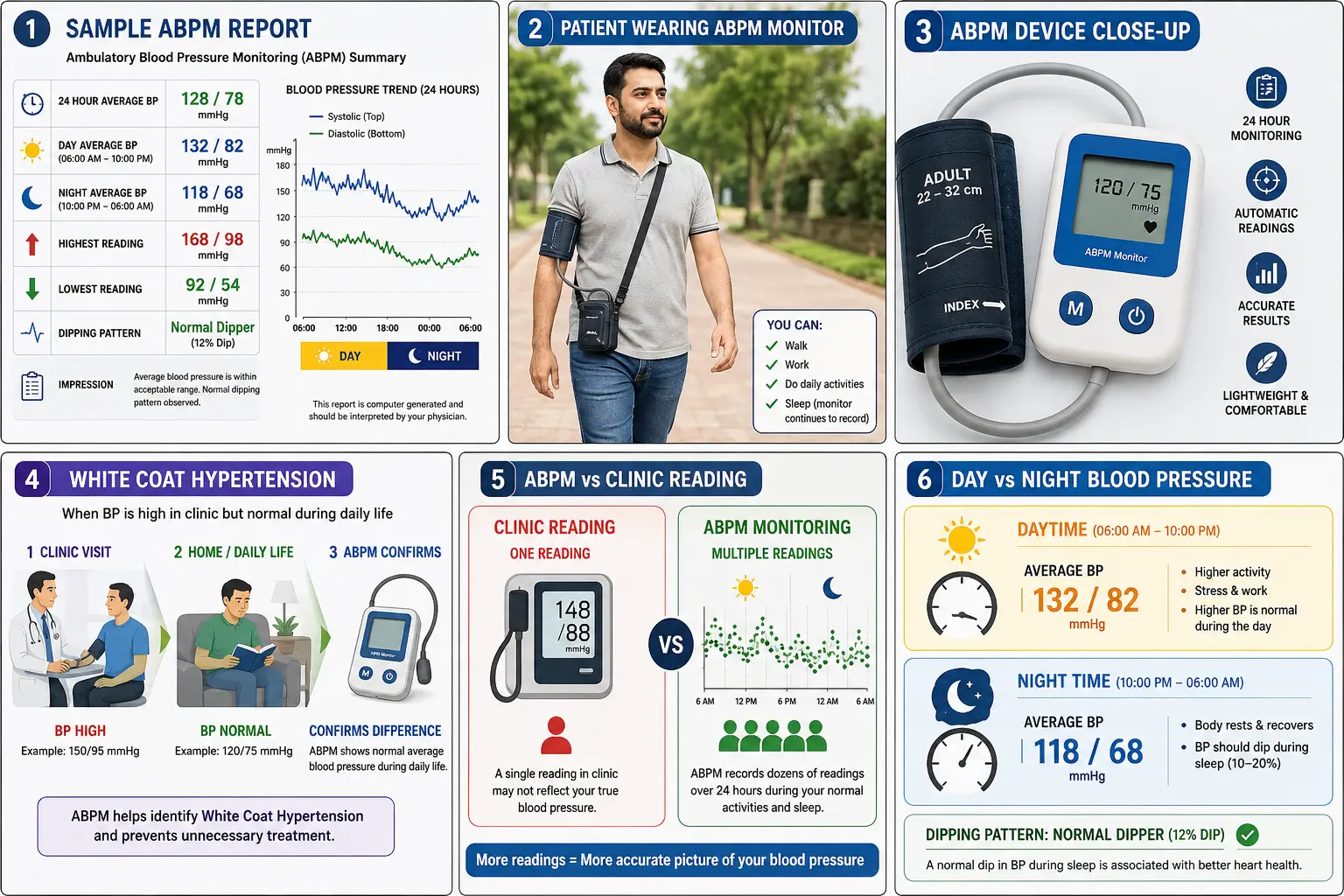
One of the biggest advantages of ABPM is that it does not rely on a single reading. Instead, dozens of blood pressure measurements are collected throughout the day and night.
Doctors look for patterns rather than focusing on one isolated number. They review how blood pressure behaves while you are awake, asleep, active and resting.
This broader picture often provides more useful information than a single clinic reading.
These readings show how blood pressure behaves during work, household activities, walking, stress and other daily situations.
Blood pressure normally falls during sleep. Monitoring overnight readings helps doctors understand whether this natural pattern is occurring.
The hours immediately after waking can be important because blood pressure often rises during this period.
This provides an overall picture of blood pressure control throughout the entire monitoring period.
Many patients notice the words Dipper or Non-Dipper on their report and wonder what they mean.
Under normal circumstances, blood pressure usually falls while a person is asleep. This overnight reduction is commonly referred to as the dipping pattern.
When blood pressure decreases appropriately during sleep, the report may describe the patient as a "Dipper."
If blood pressure does not fall as expected overnight, the report may describe a "Non-Dipper" pattern.
These findings are interpreted by the reporting doctor together with symptoms, medical history and other investigations.
Blood pressure naturally rises after waking up and becoming active. This increase is known as the morning surge.
ABPM helps doctors understand how significant this increase is and whether blood pressure remains within an acceptable range during the early part of the day.
Because clinic visits rarely occur immediately after waking, ABPM can provide information that might otherwise be missed.
Many doctors recommend making brief notes about important activities and symptoms during the monitoring period.
A simple diary can help correlate blood pressure readings with events that occurred during the day.
| Time | Activity Or Event | What To Record |
|---|---|---|
| 08:00 AM | Blood Pressure Medicine Taken | Record the time medication was taken. |
| 10:30 AM | Office Work | Note if feeling stressed or relaxed. |
| 02:00 PM | Headache | Record severity and duration. |
| 06:00 PM | Evening Walk | Record physical activity. |
| 10:30 PM | Sleep | Record approximate sleeping time. |
Medical terminology can sometimes sound intimidating. The following explanations may help patients better understand commonly used report terms.
The average blood pressure calculated from multiple readings over a defined period.
Average blood pressure during waking hours.
Average blood pressure recorded while sleeping.
The expected reduction in blood pressure during sleep.
The natural increase in blood pressure after waking.
The degree to which blood pressure changes throughout the day.
Easily accessible from multiple areas of Srinagar and nearby districts.
ABPM is available alongside other cardiac and diagnostic investigations.
Patients can contact the clinic regarding preparation and scheduling.
Clear instructions help patients understand the process before and during monitoring.
Although many patients visiting Orbit Diagnostics & Healthcare are from Srinagar city, referrals for ABPM testing frequently come from surrounding districts throughout Kashmir as well.
Some patients are referred after repeated high blood pressure readings in clinics. Others are advised to undergo ABPM because blood pressure remains difficult to control despite medication.
Patients also commonly undergo ABPM when doctors want to evaluate blood pressure during sleep, investigate suspected white coat hypertension or review the effectiveness of treatment over a full 24-hour period.
People regularly travel from Budgam, Ganderbal, Pulwama, Shopian, Kulgam, Anantnag, Baramulla, Bandipora, Kupwara and neighbouring areas for blood pressure monitoring and other diagnostic investigations.
Many people feel a little uncertain before their first ABPM appointment. Some worry they will not be able to sleep. Others wonder whether the monitor will interfere with work, travel or daily activities.
In reality, most patients complete the monitoring period with very little disruption to their normal routine. After the first few readings, many people become accustomed to the cuff and continue their day as usual.
The value of ABPM lies in the information it provides. Instead of relying on a single blood pressure reading, your doctor receives a detailed picture of how blood pressure behaves throughout an entire day and night.
Whether the report confirms good blood pressure control or identifies an issue that requires attention, the information gained can help guide future medical decisions with greater confidence.
Whether your doctor has recommended Ambulatory Blood Pressure Monitoring, you have concerns about fluctuating blood pressure or you would simply like to understand the process better, our team is available to help.
Contact Orbit Diagnostics & Healthcare for appointment information, preparation guidance and scheduling support.
The following questions are based on what patients commonly ask before booking a 24-hour blood pressure monitoring test.
ABPM stands for Ambulatory Blood Pressure Monitoring, a test that records blood pressure automatically over a 24-hour period.
Doctors commonly recommend ABPM to evaluate high blood pressure, fluctuating readings, white coat hypertension and treatment effectiveness.
No. The cuff inflates periodically and may briefly feel tight, but the test is generally well tolerated.
Most ABPM studies are performed over a 24-hour period.
Yes. The monitor continues recording while you sleep.
The frequency varies depending on device settings, but readings are generally taken regularly throughout the day and night.
In most cases, yes. Patients are encouraged to continue their normal routine.
Many patients continue routine driving, depending on symptoms and their doctor's advice.
No. The monitor should remain dry during the monitoring period.
No. The monitor should remain attached throughout the recording period.
No. Fasting is usually not required.
Patients generally continue medicines as prescribed unless instructed otherwise by their doctor.
White Coat Hypertension refers to blood pressure that becomes elevated mainly during clinic visits but remains lower during normal daily activities.
ABPM provides valuable information that helps doctors evaluate blood pressure patterns and support diagnosis.
Reporting time varies depending on analysis and review requirements. Patients can ask about expected timelines when booking.
Availability depends on appointment schedules and equipment availability. Contact the clinic for current availability.
Bring your prescription, medication list and any relevant blood pressure records or medical reports.
ABPM testing is available at Orbit Diagnostics & Healthcare, Baghat Chowk, Srinagar.
Not everyone who undergoes Ambulatory Blood Pressure Monitoring has obvious symptoms. Some people feel completely well and only discover high blood pressure during a routine check-up. Others experience symptoms that prompt their doctor to investigate further.
While ABPM is not used to diagnose every cause of these symptoms, it can provide valuable information about how blood pressure behaves throughout the day and night.
Blood pressure remains elevated during clinic visits and doctors want to confirm whether it stays high throughout the day.
Some patients with recurring headaches may be advised to undergo blood pressure monitoring as part of a broader evaluation.
ABPM can help identify whether blood pressure changes are occurring during episodes of dizziness.
Blood pressure appears normal on some days and elevated on others.
Doctors may wish to evaluate how well medication is controlling blood pressure throughout a full day.
Blood pressure appears high during clinic visits but may be normal during daily life.
| ABPM Can Help Show | ABPM Cannot Directly Show |
|---|---|
| Daytime Blood Pressure Patterns | Heart Valve Problems |
| Night-Time Blood Pressure | Blocked Heart Arteries |
| Blood Pressure Variability | Heart Structure Abnormalities |
| Response To Blood Pressure Medication | Blood Clots |
| White Coat Hypertension | Detailed Heart Rhythm Analysis |
| Morning Blood Pressure Surge | Problems Requiring Ultrasound Imaging |
ABPM is a powerful tool for understanding blood pressure behaviour, but it is often interpreted alongside clinical examination, ECG, Echocardiography (Echo) and other investigations when needed.
Patients often confuse these two tests because both involve wearing a portable monitor for an extended period.
| Feature | ABPM | Holter Monitoring |
|---|---|---|
| Measures | Blood Pressure | Heart Rhythm |
| Main Device | Blood Pressure Cuff | Chest Electrodes & Recorder |
| Primary Purpose | Evaluate Hypertension | Evaluate Arrhythmias |
| Records During Sleep | Yes | Yes |
| Used For Palpitations | No | Commonly Yes |
| Used For Blood Pressure Assessment | Yes | No |
If your doctor wants to understand what your blood pressure is doing throughout the day, ABPM is usually the preferred test. If your doctor wants to know what your heart rhythm is doing throughout the day, Holter Monitoring is usually the preferred test.
Many patients collect their report and immediately begin searching unfamiliar terms online. Words such as "non-dipper", "morning surge", "daytime average" or "blood pressure variability" can sound concerning when read without context.
The most important thing to remember is that ABPM reports are designed for medical interpretation. Individual numbers and terms only tell part of the story.
Doctors review the report together with your symptoms, medical history, medications, previous blood pressure readings and other investigations before making recommendations.
For this reason, it is always best to discuss the findings with the doctor who requested the test rather than drawing conclusions from a single number or phrase.
ABPM is not only used for patients who already have a diagnosis of high blood pressure. In many situations, doctors recommend the test when they need a clearer understanding of blood pressure patterns outside the clinic environment.
| Situation | Why ABPM May Be Helpful |
|---|---|
| Recently Diagnosed Hypertension | Provides a more complete picture of blood pressure behaviour over a full day. |
| Borderline Blood Pressure Readings | Helps determine whether elevated readings are persistent or occasional. |
| Blood Pressure Controlled In Clinic But Symptoms Continue | May identify fluctuations occurring outside the healthcare setting. |
| Blood Pressure Medication Review | Evaluates whether treatment is providing adequate 24-hour control. |
| Suspected White Coat Hypertension | Determines whether blood pressure remains elevated during normal daily activities. |
| Suspected Masked Hypertension | Identifies patients whose clinic readings appear normal but whose blood pressure rises during everyday life. |
Patients often leave with a report but are not always sure which questions are most important during follow-up.
ABPM collects readings while you carry out your usual activities rather than while sitting in a clinic for a few minutes.
One of the unique advantages of ABPM is its ability to monitor blood pressure overnight.
Instead of relying on one or two measurements, dozens of readings are recorded.
ABPM is widely used to evaluate blood pressure patterns and support hypertension assessment.
Patients typically continue their normal daily routine and sleep at home.
No injections, needles or blood samples are required for routine ABPM monitoring.
Blood pressure can change gradually over time, often without producing obvious symptoms. Many people are surprised to discover elevated blood pressure during a routine check-up because they otherwise feel completely well.
This is one reason doctors place so much importance on accurate blood pressure assessment. Understanding how blood pressure behaves during everyday life can help guide treatment decisions, lifestyle recommendations and long-term monitoring plans.
When questions remain after a clinic reading, ABPM can provide valuable additional information that may not be visible during a short office visit.
The information on this page is intended for patient education and general awareness regarding Ambulatory Blood Pressure Monitoring (ABPM). It should not replace professional medical advice, diagnosis or treatment.
Patients should discuss symptoms, test results and treatment decisions directly with their treating physician or healthcare professional.
Medical content on this page is periodically reviewed and updated to maintain accuracy and relevance.
Medical content published by Orbit Diagnostics & Healthcare is reviewed periodically to help ensure accuracy, relevance and alignment with accepted diagnostic imaging practices.
Lead Medical Reviewer
Dr. Ujala Gulzar
MBBS, MD
Note: Content is intended for educational purposes and does not replace professional medical advice, diagnosis or treatment.