Level II Anomaly Scan in Srinagar
Disclaimer: This page is intended to support patient understanding and should not replace professional medical advice, diagnosis or treatment.
Disclaimer: This page is intended to support patient understanding and should not replace professional medical advice, diagnosis or treatment.
A Level II Anomaly Scan is one of the most important ultrasound examinations during pregnancy. Usually performed between 18 and 22 weeks, this detailed scan evaluates your baby's growth, development and major anatomical structures while providing valuable information about the overall progress of the pregnancy.
At Orbit Diagnostics & Healthcare, we understand how important this stage of pregnancy is for expecting parents. Our approach focuses on careful assessment, detailed reporting and a comfortable experience so that families can move forward with greater confidence and clarity.
What Is a Level II Anomaly Scan?
A Level II Anomaly Scan, often referred to as the 20-week pregnancy scan, is a detailed ultrasound examination performed during the second trimester. Unlike routine pregnancy ultrasounds that mainly confirm fetal growth and wellbeing, this examination focuses on evaluating important anatomical structures and developmental milestones in greater detail.
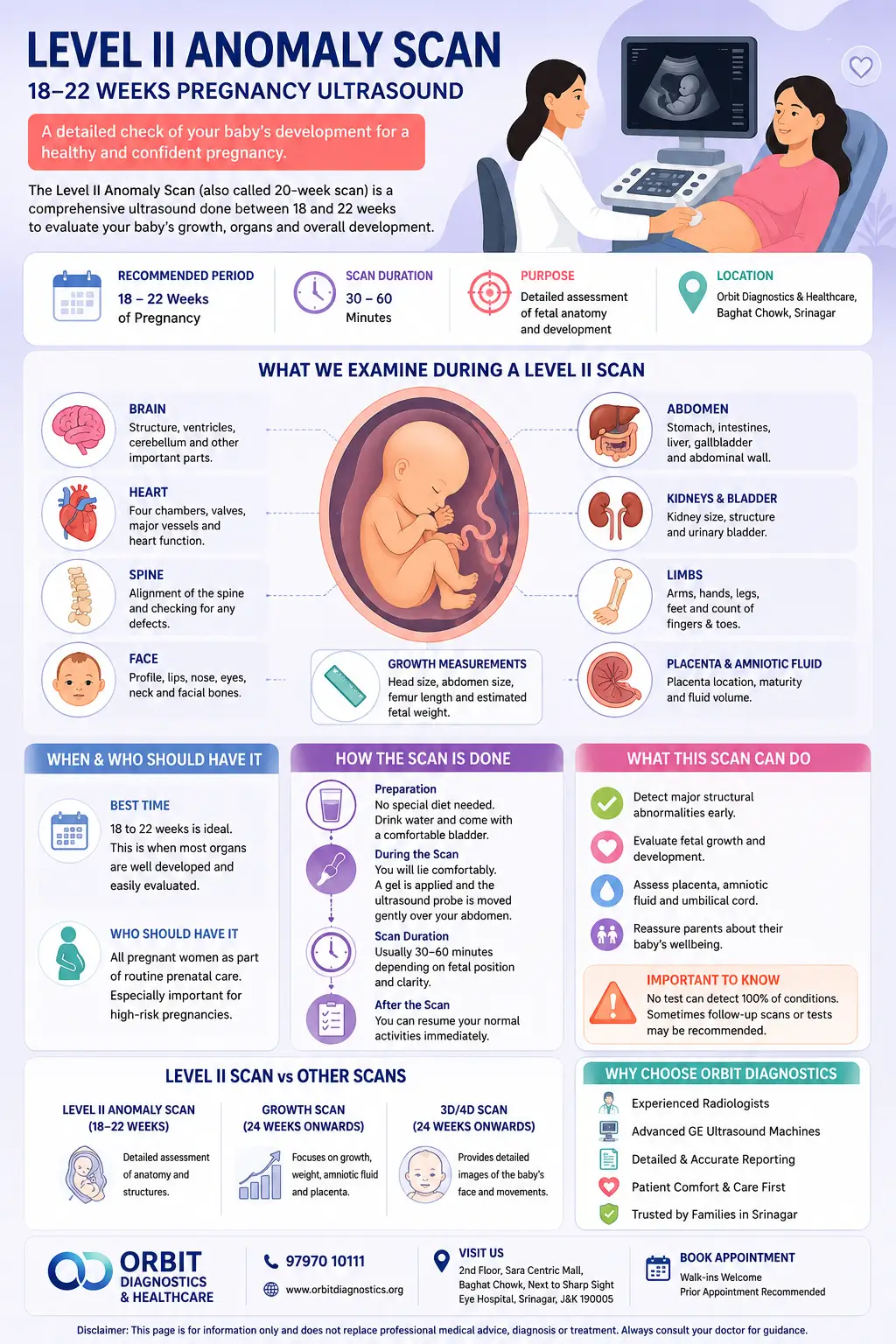
During the scan, various parts of the baby's body are carefully assessed, including the brain, face, heart, spine, stomach, kidneys, bladder, arms and legs. The examination also includes assessment of the placenta, amniotic fluid and fetal growth measurements. Together, these observations help provide a comprehensive overview of the pregnancy at this important stage.
For many families, this appointment represents one of the most memorable milestones of pregnancy. Parents often have an opportunity to see their baby's movements more clearly and gain a better understanding of how development is progressing. At the same time, the examination provides valuable clinical information that can support ongoing prenatal care.
Although no ultrasound examination can identify every possible condition before birth, a Level II Anomaly Scan remains one of the most important assessments available during pregnancy and is widely recommended as part of routine prenatal care.
Why Is This Scan Important During Pregnancy?
The second trimester is a period of significant growth and development. By this stage, many of the baby's organs and body systems have developed sufficiently to allow a detailed ultrasound assessment. This makes the Level II Anomaly Scan an important opportunity to evaluate fetal anatomy and monitor the overall progress of the pregnancy.
The information obtained during the examination can help healthcare providers better understand fetal development, identify findings that may require additional monitoring and support informed pregnancy care. For parents, the scan often provides reassurance and a deeper connection with their growing baby.
At Orbit Diagnostics & Healthcare, we believe that every pregnancy deserves careful attention. We perform each Level II Anomaly Scan with patience, professionalism and a strong commitment to diagnostic quality. Our goal is to provide expecting parents and referring doctors with accurate information presented in a clear and meaningful way.
What Do We Examine During a Level II Anomaly Scan?
One of the most common questions parents ask is, "What exactly do you look at during the scan?" The answer is that this examination involves a detailed assessment of several important aspects of your baby's development. Rather than focusing on a single area, the scan provides a broader picture of fetal growth and anatomy at this stage of pregnancy.
During the examination, different parts of the baby's body are carefully assessed, measured and documented. The findings help provide valuable information about fetal development and can assist healthcare providers in monitoring the pregnancy more effectively.
| Area Assessed | What Is Evaluated |
|---|---|
| Brain & Head | Development, structure and standard measurements |
| Face | Facial profile and visible anatomical features |
| Heart | Position, chambers and visible cardiac anatomy |
| Spine | Alignment and appearance of spinal structures |
| Abdomen | Stomach and other visible abdominal structures |
| Kidneys & Bladder | Presence and appearance of urinary structures |
| Arms & Legs | Growth and visible limb development |
| Placenta | Position and relationship to the pregnancy |
| Amniotic Fluid | Fluid volume assessment |
| Growth Measurements | Measurements used to monitor fetal development |
Because every baby moves differently and may not always cooperate during imaging, obtaining the required views sometimes takes patience and additional time. Our goal is always to complete a careful and comprehensive examination rather than rushing through the process.
Assessment of the Baby's Brain, Heart and Spine
The brain, heart and spine are among the most important areas examined during a Level II Anomaly Scan. These structures undergo significant development during pregnancy, making the second trimester an ideal time for detailed ultrasound evaluation.
The baby's brain is assessed using standard ultrasound views that allow evaluation of important structures and measurements. The shape of the skull and visible intracranial anatomy are carefully reviewed as part of the examination.
The fetal heart is also examined in detail. Because the heart is constantly moving and relatively small, obtaining appropriate images requires experience, attention to detail and careful scanning technique. Various views are used to assess the visible anatomy and overall appearance of the heart.
The spine is evaluated from multiple angles whenever possible. This assessment contributes to the overall anatomical examination and helps provide additional information regarding fetal development.
While many parents are excited to watch their baby moving on the screen, our primary focus remains on obtaining the images and measurements needed for a thorough and reliable assessment.
Assessment of the Abdomen, Kidneys and Limbs
The examination also includes assessment of important abdominal structures, including the stomach and other visible organs. The kidneys and bladder are evaluated as part of the overall review of fetal anatomy.
The baby's arms, hands, legs and feet are visualised whenever possible. At this stage of pregnancy, fetal movements are often clearly visible and many parents enjoy seeing their baby stretch, kick or change position during the examination.
Every pregnancy is different, and imaging quality can be influenced by several factors including fetal position, maternal body habitus and gestational age. For this reason, some examinations may require additional time to obtain the views needed for proper assessment.
Assessment of the Placenta and Amniotic Fluid
A healthy pregnancy involves more than the baby alone. The placenta and amniotic fluid play essential roles in supporting growth and development throughout pregnancy.
During the Level II Scan, the location of the placenta is assessed along with observations regarding its appearance. The amount of amniotic fluid surrounding the baby is also evaluated as part of the overall examination.
These findings help create a more complete picture of the pregnancy and provide additional information that may assist in ongoing prenatal care.
Growth Measurements and Developmental Assessment
Several standard measurements are obtained during the examination to assess fetal growth and development. These measurements are compared with expected ranges for the stage of pregnancy and help provide valuable information regarding overall progress.
It is important to understand that every baby grows at a slightly different pace. Small variations in measurements are common and are interpreted within the broader context of the pregnancy rather than as isolated findings.
The combination of anatomical assessment, growth measurements, placental evaluation and amniotic fluid assessment makes the Level II Anomaly Scan one of the most informative ultrasound examinations performed during pregnancy.
How We Perform a Level II Anomaly Scan at Orbit Diagnostics & Healthcare
We understand that many expecting parents arrive for their Level II Scan with a mixture of excitement and anxiety. Some are eager to see their baby again, while others are concerned about whether everything is progressing normally. Our goal is to make the experience as comfortable, informative and reassuring as possible while maintaining the highest standards of diagnostic care.
Unlike a quick routine ultrasound, a Level II Anomaly Scan requires time, concentration and a systematic approach. At Orbit Diagnostics & Healthcare, we never rush this examination. Every scan is performed with careful attention to detail because the information obtained can play an important role in ongoing pregnancy care.
Your Journey From Appointment to Report
Step 1
Appointment Scheduling
You can schedule your appointment by phone, WhatsApp or by visiting our reception desk. During booking, our team may ask about your pregnancy duration and previous scans to ensure that the examination is scheduled at the appropriate time.
Step 2
Arrival at the Clinic
Upon arrival, our reception team will assist with registration and verification of your details. If you have previous ultrasound reports or referral notes from your doctor, bringing them along may be helpful.
Step 3
Ultrasound Examination
The scan is performed using advanced ultrasound equipment. Multiple images and measurements are obtained while different parts of the baby's body are carefully assessed.
Step 4
Review & Reporting
Following the examination, images and measurements are reviewed before the final report is prepared. This helps ensure clarity, completeness and accuracy.
How to Prepare for Your Appointment
Preparation requirements may vary depending on the stage of pregnancy and your doctor's recommendations. Our team will guide you regarding any specific instructions when you book your appointment.
In general, we recommend arriving a few minutes before your scheduled appointment so that registration can be completed comfortably without feeling rushed.
If available, please bring:
- Previous pregnancy ultrasound reports
- Referral note from your doctor
- Relevant medical records
- Identification if required for registration
- Any reports related to the current pregnancy
Having access to previous information can sometimes assist in understanding the overall progress of the pregnancy.
How Your Report Is Prepared
Once the examination is complete, the recorded images and measurements are reviewed before the report is finalised. This stage is important because it allows findings to be documented accurately and comprehensively.
Our objective is to provide reports that are clear, clinically meaningful and useful for both patients and referring healthcare professionals.
Report availability may vary depending on the complexity of the examination and reporting requirements. Our reception team will advise you regarding expected collection times.
When Is the Best Time to Have a Level II Anomaly Scan?
Timing is extremely important when it comes to a Level II Anomaly Scan. The examination is usually performed between 18 and 22 weeks of pregnancy because, during this period, the baby's organs and body structures have developed sufficiently to allow a detailed ultrasound assessment.
Many healthcare providers recommend scheduling the scan around the twentieth week of pregnancy. At this stage, important anatomical structures can generally be visualised more clearly, allowing a comprehensive assessment of fetal development.
If the examination is performed too early, certain structures may not yet be developed enough for complete evaluation. If performed much later, fetal position and growth can occasionally make assessment more challenging.
If you are unsure about the ideal timing for your scan, our team can guide you based on your pregnancy dates and previous ultrasound findings.
Who Should Have a Level II Anomaly Scan?
A Level II Anomaly Scan is generally recommended for all pregnant women, regardless of whether the pregnancy is considered low-risk or high-risk.
Many people mistakenly believe that this examination is only necessary when there are known medical concerns. In reality, the scan is an important part of routine prenatal care because it provides valuable information about fetal anatomy and development.
Even when earlier pregnancy scans appear normal, the Level II Scan remains important because it evaluates structures that cannot be fully assessed during the first trimester.
The examination provides reassurance for many families while also helping healthcare providers monitor the pregnancy more effectively.
Why Is It Especially Important in High-Risk Pregnancies?
While the scan is valuable for every pregnancy, it becomes particularly important when additional monitoring is required due to maternal health conditions, previous pregnancy history or specific clinical concerns.
Healthcare providers may place additional emphasis on detailed fetal assessment in situations involving:
- Diabetes during pregnancy
- High blood pressure
- Twin or multiple pregnancies
- Previous pregnancy complications
- History of congenital abnormalities
- Advanced maternal age
- Certain hereditary conditions
- Abnormal findings on earlier scans
The purpose of the examination is not to create anxiety but rather to obtain information that may assist in providing the most appropriate pregnancy care.
Is a Level II Anomaly Scan Safe for Mother and Baby?
Safety is one of the most common concerns among expecting parents. Fortunately, ultrasound has been used in pregnancy care for many decades and remains one of the most widely utilised diagnostic tools in obstetric medicine.
Unlike X-rays and CT scans, ultrasound does not use ionising radiation. Instead, it uses sound waves to create images of the developing baby inside the womb.
The examination is non-invasive, painless and does not involve injections or surgical procedures. It is routinely used worldwide as part of prenatal care and fetal assessment.
When performed appropriately for medical purposes, ultrasound remains an established and important method for monitoring pregnancy and fetal development.
What Can a Level II Anomaly Scan Detect?
One of the primary purposes of a Level II Scan is to evaluate fetal anatomy in detail and identify visible findings that may require additional monitoring or further evaluation.
The scan may provide information regarding the development of structures such as:
| Area | Examples of Assessment |
|---|---|
| Brain | Structural development and measurements |
| Heart | Visible cardiac anatomy and chambers |
| Spine | Alignment and development |
| Abdomen | Stomach and abdominal structures |
| Kidneys | Presence and appearance |
| Limbs | Development of arms and legs |
| Placenta | Location and relationship to the pregnancy |
It is important to understand that no ultrasound examination can identify every possible abnormality. Some conditions may not be visible during pregnancy, while others may develop later or require different forms of evaluation.
Understanding the Limitations of Ultrasound
One of the most important aspects of responsible healthcare communication is honesty. While a Level II Anomaly Scan provides a significant amount of information, it is not a guarantee that every medical condition can be detected before birth.
Image quality and diagnostic visibility can be influenced by factors such as fetal position, gestational age, maternal body habitus and the nature of the condition being assessed.
For this reason, scan findings are always interpreted within the broader context of pregnancy care rather than in isolation.
Level II Anomaly Scan vs Growth Scan
| Level II Anomaly Scan | Growth Scan |
|---|---|
| Usually performed at 18–22 weeks | Usually performed later in pregnancy |
| Focuses on anatomy and development | Focuses on growth and wellbeing |
| Detailed organ assessment | Growth measurements and monitoring |
| Longer examination | Generally shorter examination |
| Major pregnancy milestone scan | Follow-up pregnancy assessment |
Both scans are important but serve different purposes. A Growth Scan does not replace a Level II Anomaly Scan, and vice versa.
Level II Anomaly Scan vs 3D and 4D Ultrasound
| Level II Anomaly Scan | 3D / 4D Ultrasound |
|---|---|
| Diagnostic examination | Primarily visual imaging |
| Evaluates fetal anatomy | Shows surface appearance |
| Includes measurements and assessment | Focused on visualisation |
| Recommended part of prenatal care | Supplementary imaging when appropriate |
| Clinical objective | Visual and educational objective |
Many parents assume that a 3D or 4D ultrasound is more advanced than a Level II Scan. In reality, they serve different purposes. The Level II Anomaly Scan remains one of the most important diagnostic examinations performed during pregnancy.
Why Choose Orbit Diagnostics & Healthcare for Your Level II Anomaly Scan?
Pregnancy is a journey filled with important milestones, and the Level II Anomaly Scan is one of the most significant. Choosing where to have this examination performed is not simply about convenience. It is about confidence in the examination process, trust in the reporting and knowing that your pregnancy is receiving careful attention.
At Orbit Diagnostics & Healthcare, we approach every pregnancy ultrasound with professionalism, patience and respect. We understand that every expectant mother and every family arrives with their own questions, concerns and expectations.
Our goal is to provide a comfortable environment, a thorough examination and clear reporting that can support informed healthcare decisions throughout pregnancy.
We understand the emotional importance of pregnancy-related examinations.
Every examination is performed systematically with attention to important anatomical structures.
Reports are prepared carefully and presented in a clear, understandable format.
Located at Baghat Chowk, Srinagar with easy access from surrounding areas.
Frequently Asked Questions About Level II Anomaly Scans
What is a Level II Anomaly Scan?
A detailed pregnancy ultrasound examination performed between 18 and 22 weeks to assess fetal anatomy and development.
When should I schedule the scan?
The ideal time is usually between 18 and 22 weeks of pregnancy.
How long does the examination take?
Most examinations take approximately 30 to 60 minutes depending on fetal position and imaging requirements.
Is the scan painful?
No. The examination is non-invasive and generally comfortable.
Do I need to fast before the scan?
Fasting is usually not required unless specifically advised.
Can I eat before the appointment?
In most situations, normal meals may be taken before the examination.
Do I need a full bladder?
Preparation instructions may vary depending on the stage of pregnancy. Our team will guide you when booking.
Can my husband accompany me?
Please confirm current visitor policies with our reception team when scheduling your appointment.
Will I receive images of my baby?
Available images and documentation may vary depending on clinic protocols and examination findings.
Can twins undergo a Level II Scan?
Yes. Detailed anatomical assessment is also important in twin pregnancies.
Can the scan detect all abnormalities?
No ultrasound examination can identify every possible condition. However, the Level II Scan provides valuable information regarding fetal development.
What if my baby is not in a suitable position?
You may be asked to change position, walk briefly or wait a short time while additional images are obtained.
Will I receive a report on the same day?
Report availability depends on the examination and reporting requirements. Our team will advise you accordingly.
Can this scan determine the baby's gender?
Indian law prohibits prenatal sex determination and disclosure. Orbit Diagnostics & Healthcare strictly complies with all applicable regulations.
Is the scan safe for the baby?
Ultrasound uses sound waves and does not involve ionising radiation.
Book Your Level II Anomaly Scan in Srinagar
If you are between 18 and 22 weeks pregnant and your doctor has advised a Level II Anomaly Scan, our team will be pleased to assist you.
For appointments, preparation instructions or general enquiries, please contact Orbit Diagnostics & Healthcare.
Medical Disclaimer
The information provided on this page is intended for educational and informational purposes only. It should not be considered a substitute for professional medical advice, diagnosis or treatment.
Every pregnancy is unique. Patients should always discuss medical concerns, ultrasound findings and pregnancy-related decisions with their treating doctor or qualified healthcare professional.
While ultrasound provides valuable information regarding fetal development, no examination can identify every possible condition or guarantee a particular outcome.
What Happens If an Abnormality or Concern Is Identified?
One of the questions many parents hesitate to ask is what happens if the scan identifies a finding that requires additional attention. While most Level II Anomaly Scans are reassuring, occasionally an observation may require further evaluation, follow-up imaging or consultation with your treating doctor.
If an important finding is identified, it does not automatically mean that there is a serious problem. In many cases, additional information is required before any conclusions can be reached. Some findings may simply require monitoring later in pregnancy, while others may prompt further discussion with your obstetrician or specialist.
Our role is to carefully document the findings, prepare a clear report and ensure that the information needed for appropriate medical decision-making is available to your healthcare provider.
We understand that unexpected information can be emotionally challenging for families. When additional evaluation is recommended, our team strives to communicate professionally and compassionately while encouraging patients to remain in close contact with their treating doctor.
Common Reasons Doctors Recommend a Level II Anomaly Scan
Although the scan is widely recommended as part of routine pregnancy care, there are several situations in which doctors may place particular importance on a detailed fetal assessment.
| Clinical Situation | Reason for Detailed Assessment |
|---|---|
| Routine Pregnancy Care | Assessment of fetal anatomy and development |
| Maternal Diabetes | Additional monitoring of fetal development |
| High Blood Pressure | Closer pregnancy assessment |
| Twin Pregnancy | Detailed evaluation of both babies |
| Previous Pregnancy Concerns | Additional reassurance and monitoring |
| Advanced Maternal Age | Comprehensive fetal assessment |
| Abnormal Earlier Scan Findings | Further anatomical evaluation |
Every pregnancy is unique, and the reason for referral may vary depending on individual medical circumstances. Your doctor is the best person to explain why a Level II Anomaly Scan has been recommended in your particular case.
Contact Orbit Diagnostics & Healthcare
Orbit Diagnostics & Healthcare
2nd Floor, Sara Centric Mall,
Baghat Chowk, Barzulla,
Next to Sharp Sight Eye Hospital,
Srinagar, Jammu & Kashmir – 190005
Phone: +91 97970 10111
Email: info@orbitdiagnostics.org
Working Hours:
Monday to Sunday
6:00 AM – 9:30 PM
Real Questions We Often Hear From Expecting Mothers
Pregnancy naturally brings questions, concerns and moments of uncertainty. Over the years, many expecting mothers visiting our clinic have asked similar questions before their Level II Anomaly Scan. We have included some of the most common ones below to help you feel more prepared before your appointment.
My baby was not moving during the scan. Should I be worried?
Not necessarily. Babies have active periods as well as resting periods. Some babies move throughout the examination, while others appear to be sleeping. If additional views are needed, simple measures such as changing position or waiting a short time may help.
I missed my 20-week scan. Can I still have a Level II Anomaly Scan?
In many situations, yes. If you have missed the ideal timeframe, contact our clinic or discuss the matter with your doctor. The best approach depends on how far along the pregnancy is and your individual circumstances.
What if the report recommends follow-up imaging?
Follow-up imaging does not automatically mean there is a serious concern. Sometimes additional views, repeat assessments or ongoing monitoring are recommended simply to obtain more information or track a finding over time.
Can I bring previous ultrasound reports?
Absolutely. Previous reports often provide useful information and may help your healthcare provider understand the progression of the pregnancy more clearly.
What if my baby is facing away from the ultrasound probe?
This is very common. Babies frequently change position during pregnancy. In some cases, additional time or simple position changes may help obtain the required images.
Can this scan tell me how healthy my baby will be after birth?
A Level II Anomaly Scan provides important information about fetal anatomy and development, but no ultrasound examination can predict every aspect of a baby's future health or development.
Can I undergo the scan if I feel completely healthy and my pregnancy is normal?
Yes. In fact, most Level II Anomaly Scans are performed in pregnancies that are progressing normally. The examination is considered an important part of routine prenatal assessment.
What Happens During Your Level II Anomaly Scan Appointment?
Many expecting mothers arrive for their appointment wondering exactly what will happen during the examination. Knowing what to expect can help reduce anxiety and make the experience more comfortable.
Although every pregnancy is unique, a typical Level II Anomaly Scan at Orbit Diagnostics & Healthcare follows a structured process designed to obtain detailed information about your baby's development while ensuring patient comfort throughout the examination.
Registration and Review
After arriving at the clinic, your registration details are verified. Previous ultrasound reports, referral notes and relevant pregnancy records may also be reviewed if available.
Preparation for the Examination
You will be guided to the ultrasound room where the examination procedure will be explained. Any questions you may have can be discussed before the scan begins.
Detailed Ultrasound Assessment
The radiologist carefully evaluates different parts of the baby's body including the brain, heart, spine, abdomen, kidneys, limbs, placenta and amniotic fluid. Various measurements and images are recorded during this stage.
Image Review
Recorded images and measurements are reviewed to ensure that the examination is complete and that all necessary observations have been documented.
Report Preparation
The findings are compiled into a structured report that can assist your doctor in monitoring the pregnancy and planning any required follow-up care.