24 Hour Heart Rhythm Monitoring

Holter Test in Srinagar

Disclaimer: This page is intended to support patient understanding and should not replace professional medical advice, diagnosis or treatment.

24 Hour Holter Monitoring For Palpitations, Irregular Heartbeats, Dizziness & Cardiac Rhythm Evaluation

Need Holter Test Today?

Same-day appointments may be available depending on equipment availability and existing bookings. Please call before visiting.

If your doctor has advised a Holter test, you're probably looking for straightforward answers rather than medical jargon. Most patients want to know where they can get the test done, whether it is available today, how much it costs, whether they can go to work while wearing the device, if they can sleep normally, and when the report will be ready.

At Orbit Diagnostics & Healthcare, Srinagar, Holter Monitoring is available for continuous recording of heart rhythm during normal day-to-day activities. Unlike a routine ECG that records only a few seconds of heart activity, a Holter monitor continuously records every heartbeat for an extended period, helping doctors identify rhythm disturbances that may not appear during a short ECG examination.

Many patients are referred for Holter Monitoring after experiencing palpitations, skipped heartbeats, dizziness, fainting episodes, unexplained chest discomfort or symptoms that come and go throughout the day. Because the recording continues while you carry out your normal routine, it often provides information that a routine ECG cannot capture.
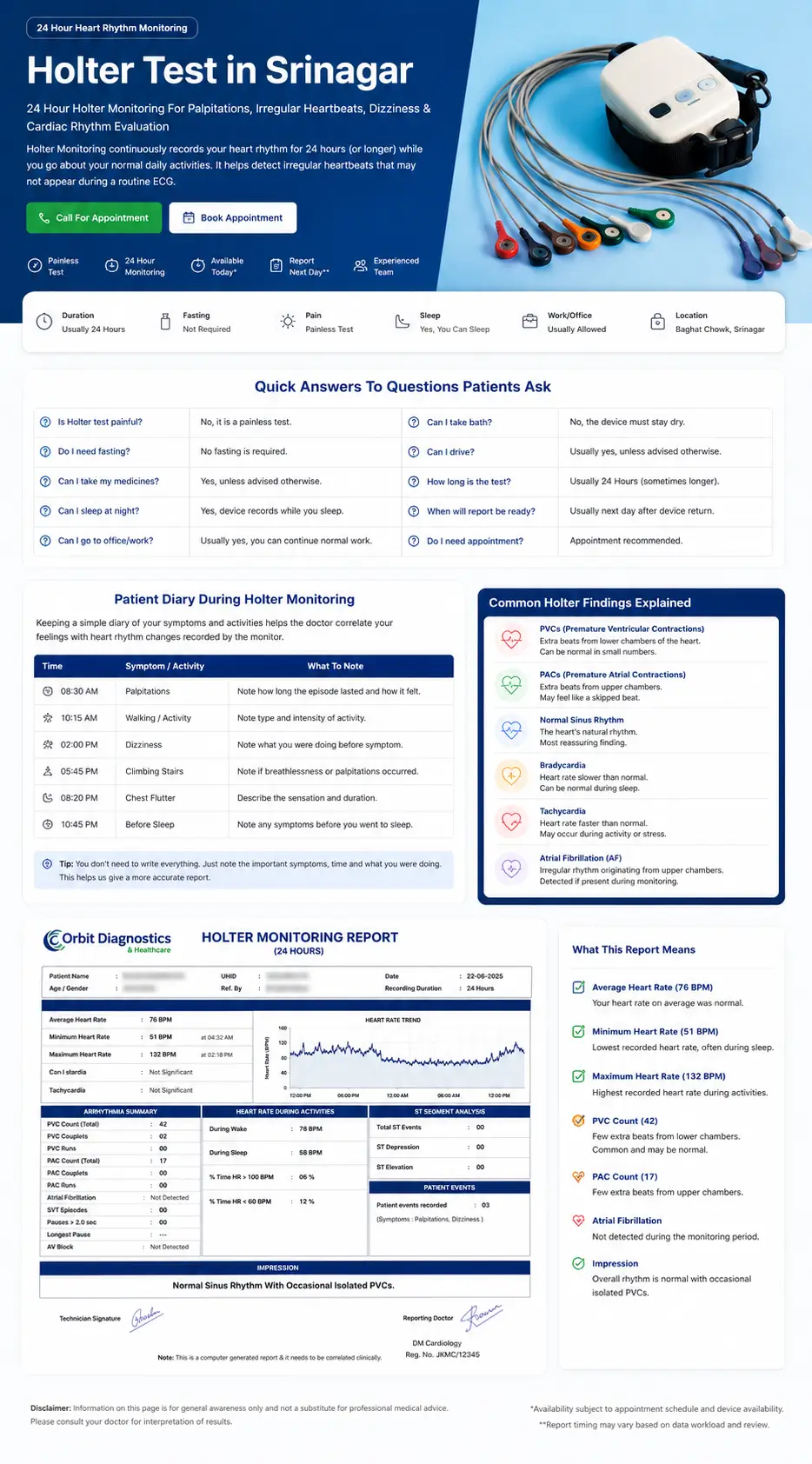
Holter Test At A Glance

  • Test Name: Holter Monitoring
  • Purpose: Continuous heart rhythm recording
  • Duration: Usually 24 Hours
  • Pain: No needles, usually painless
  • Need Fasting? No
  • Can I Sleep With It? Yes
  • Can I Go To Work? Usually Yes
  • Can I Drive? Usually Yes
  • Can I Bathe? No, device must stay dry
  • Report: After data analysis and review
  • Location: Baghat Chowk, Srinagar

Quick Answers To Questions Patients Ask Before Booking

Before calling a clinic, most people already have a list of questions in mind. Here are some of the most common ones we hear from patients and family members every week.

Question Quick Answer
Is Holter Monitoring Painful? No. Small adhesive electrodes are attached to the chest. No injections or needles are involved.
Can I Sleep While Wearing It? Yes. The monitor is specifically designed to continue recording during sleep.
Can I Go To Office Or College? In most cases, yes. Patients are encouraged to continue normal daily activities.
Do I Need Fasting? No fasting is usually required.
Can I Take My Regular Medicines? Usually yes, unless your doctor has given different instructions.
How Long Does The Test Last? Most commonly 24 hours, though longer monitoring may sometimes be advised.
Can I Remove The Device At Night? No. The monitor should remain connected throughout the recording period.
Will The Device Be Visible? The recorder is small and can usually be concealed under normal clothing.

Why Has My Doctor Recommended A Holter Test?

One of the most common things patients say when they arrive is:

"My ECG was normal. Why do I still need another heart test?"

The answer is actually quite simple. A routine ECG records only a few seconds of heart activity. If your symptoms don't occur during those few seconds, the ECG may appear completely normal even though the problem happens later in the day. Holter Monitoring solves this problem by continuously recording heart activity while you go about your normal routine.

Palpitations

Many people describe palpitations as fluttering, pounding, racing or skipped heartbeats. If these episodes happen only occasionally, a routine ECG may miss them. Continuous monitoring increases the chance of capturing the rhythm during symptoms.

Irregular Heartbeats

Some patients notice sudden changes in pulse rate or an irregular heartbeat that comes and goes. Holter Monitoring can help document these episodes when they occur.

Dizziness Or Lightheadedness

When dizziness occurs repeatedly without a clear explanation, doctors may wish to check whether temporary rhythm abnormalities are occurring at the same time.

Fainting Episodes

Episodes of unexplained fainting or near-fainting may sometimes require evaluation of heart rhythm over a longer period.

Follow-Up After Heart Treatment

Doctors may use Holter Monitoring to assess how a previously diagnosed rhythm condition is behaving or how treatment is working.

Normal ECG But Symptoms Continue

This is one of the most common reasons for referral. Symptoms may occur several hours after an ECG has been performed, making longer monitoring helpful.

A Thought That Worries Many Patients

Many people become anxious when they hear the words "heart monitoring". Some immediately assume that something serious has already been found. In reality, Holter Monitoring is often recommended simply because a doctor wants more information before making any conclusions.

In many cases, the test is requested because symptoms are occurring intermittently and the doctor wants to understand exactly what the heart is doing during those moments. Sometimes the findings are completely reassuring. Sometimes they help explain symptoms that have been bothering a patient for weeks or months.

The purpose of the test is not to alarm you. The purpose is to collect information that cannot be captured during a brief ECG examination.

What Is A Holter Monitor?

The easiest way to understand a Holter monitor is to think of it as a portable ECG that stays with you throughout the day.

A routine ECG records only a few seconds of your heart's electrical activity while you are lying still on an examination couch. A Holter monitor does something very different.

It continuously records every heartbeat while you walk, work, eat, sleep, climb stairs, watch television and carry out your normal daily activities.

Because the recording continues for an extended period, it can capture rhythm disturbances that may occur only occasionally and may not appear during a routine ECG.

The monitor itself is small, lightweight and designed to be worn comfortably under normal clothing. A few adhesive electrodes are placed on the chest and connected to a compact recorder that continuously stores heart rhythm data.

For many patients, the most surprising part of the test is how normal life feels while wearing the device. After a short period, most people barely notice it is there.

Holter Monitoring Vs ECG

Many patients assume these are the same test. They are related, but they answer different clinical questions.

Feature Routine ECG Holter Monitoring
Recording Duration A Few Seconds Usually 24 Hours
Performed At Clinic Only Yes No
Records During Sleep No Yes
Records During Daily Activities No Yes
Detects Intermittent Rhythm Problems May Miss Them Higher Chance Of Detection
Portable Device No Yes
Useful When Symptoms Come And Go Limited Very Helpful

Doctors often request both tests because each provides different information about the heart.

What Happens During A Holter Test?

Patients often imagine complicated machines, wires everywhere and restrictions on movement. The reality is usually much simpler.

01

Registration

The appointment begins with registration and review of any prescription, ECG reports, Echo reports or medical records you have brought with you.

02

Preparation Of The Chest

The skin is prepared so that the electrodes can adhere properly and maintain a reliable recording.

03

Electrodes Applied

Small adhesive electrodes are placed on the chest and connected to the recording device.

04

Monitor Attached

The compact recorder is attached and secured comfortably so you can continue normal activities.

05

Go About Your Day

You leave the clinic and continue your routine while the monitor records every heartbeat.

06

Sleep With The Device

The monitor continues recording while you sleep, which is often an important part of the evaluation.

07

Return To Clinic

After the monitoring period is complete, the recorder is returned for analysis.

08

Data Review & Reporting

The recorded information is analysed and prepared for clinical review and reporting.

Can I Live Normally While Wearing A Holter Monitor?

This is one of the first questions almost every patient asks. The short answer is yes. In fact, doctors usually want you to continue your normal routine because the goal is to see how your heart behaves during everyday life.

Activity Usually Allowed? Notes
Walking ✓ Yes Normal walking is encouraged.
Office Work ✓ Yes Most office duties can continue normally.
College Or School ✓ Yes Most routine attendance is possible.
Driving ✓ Usually Depends on your symptoms and doctor's advice.
Sleeping ✓ Yes Recording continues throughout the night.
Using Mobile Phone ✓ Yes Normal use is usually fine.
Taking A Bath ✗ No The monitor must remain dry.
Swimming ✗ No Water can damage the recorder.

What Should I Wear For A Holter Test?

This may sound like a small detail, but choosing comfortable clothing can make the monitoring period easier.

Loose-fitting shirts, kurtas, sweaters and tops generally work well because they allow the recorder to remain comfortably concealed beneath clothing.

Very tight clothing may sometimes make the wires less comfortable during prolonged wear.

Many patients simply wear their normal everyday clothing and experience no difficulty at all.

Things Patients Often Worry About

Will People Notice The Device?

In most situations the recorder remains hidden beneath normal clothing and is not obvious to others.

Can I Sleep Comfortably?

Most patients adapt quickly and sleep normally while the monitor continues recording.

Can The Device Give Me A Shock?

No. The monitor only records information. It does not deliver electricity to the body.

Will The Electrodes Hurt?

The electrodes are adhesive patches similar to those used during an ECG and are generally well tolerated.

Can I Travel Across Srinagar While Wearing It?

Most routine travel can continue normally unless your doctor has provided specific restrictions.

Can Elderly Patients Wear A Holter Monitor?

Yes. Holter Monitoring is commonly performed for patients of various age groups when clinically indicated.

How Much Does A Holter Test Cost?

One of the most common questions patients ask before booking a Holter test is about the cost. The answer depends on several factors, including the duration of monitoring, the type of recording device being used and the city where the test is performed.

A standard 24-hour Holter Monitoring study is usually the most commonly requested option and is often recommended when patients experience symptoms such as palpitations, skipped heartbeats, dizziness or unexplained episodes of rapid heartbeat.

In India, the cost of Holter Monitoring can vary considerably between healthcare facilities. Large metropolitan hospitals often charge differently from independent diagnostic centres, and longer monitoring periods generally cost more because additional recording and analysis are required.

Monitoring Duration Typical Cost Range (INR) Common Reason For Monitoring
24-Hour Holter Monitoring ₹1,500 – ₹5,000 Often recommended for evaluation of palpitations, dizziness and occasional irregular heartbeats.
48-Hour Holter Monitoring ₹7,500 – ₹8,000 May be advised when symptoms do not occur every day.
72-Hour Holter Monitoring ₹6,000 – ₹12,000 Useful when heart rhythm changes occur less frequently.
5 To 7-Day Monitoring ₹11,700 – ₹26,000 May be considered for infrequent rhythm disturbances that are difficult to capture during shorter monitoring periods.

The figures above represent commonly reported market ranges and are intended only as a general guide. Actual charges may vary between healthcare providers and regions.

Estimated Holter Test Costs In Major Indian Cities

Healthcare costs can vary significantly from one city to another. The following examples provide a broad overview of commonly observed pricing ranges across different regions of India.

City Estimated Cost Range
Delhi NCR Approximately ₹1,500 onwards at diagnostic centres. Home-based services may start around ₹2,999 depending on provider availability.
Mumbai Typically around ₹4,500 and above depending on facility and reporting requirements.
Lucknow Generally around ₹4,500 onwards.
Dehradun Often starts from approximately ₹4,500.
Hyderabad Commonly ranges between ₹4,500 and ₹6,500 depending on provider and monitoring duration.

Why Do Holter Monitoring Charges Differ?

Patients are sometimes surprised to see significant differences in pricing between cities and healthcare facilities. This happens because Holter Monitoring involves more than simply wearing a recording device. The test also requires downloading, analysing and reviewing thousands of recorded heartbeats before a report can be prepared.

Factors such as monitoring duration, equipment used, reporting workflow, location and healthcare provider policies can all influence the final cost.

For the most up-to-date pricing and appointment availability, patients are encouraged to contact the clinic directly before scheduling the examination.

Why Can Holter Monitoring Prices Differ Between Clinics?

Monitoring Duration

Some patients require standard 24-hour monitoring, while others may require longer recording periods depending on their symptoms and doctor's recommendation.

Data Analysis Requirements

A Holter monitor records thousands of heartbeats. The amount of data requiring analysis can influence reporting complexity.

Type Of Facility

Diagnostic centres, speciality clinics and large hospitals often have different operational structures and pricing models.

Clinical Review Process

The review and interpretation process is an important part of Holter Monitoring and contributes significantly to the value of the examination.

How Should I Prepare For A Holter Test?

One of the advantages of Holter Monitoring is that preparation is usually straightforward. Most patients can continue their normal daily routine before the appointment.

Before You Arrive

  • Bring your doctor's referral if available.
  • Carry previous ECG reports.
  • Bring previous Echo reports if you have them.
  • Carry a list of medicines you are currently taking.
  • Wear comfortable clothing.
  • Arrive a little before your scheduled appointment time.
  • Inform the healthcare team about any recent cardiac procedures or hospital admissions.
  • Bring any previous Holter reports if you have undergone monitoring before.

Common Preparation Questions

Do I Need To Fast?

For routine Holter Monitoring, fasting is generally not required. Most patients can eat and drink normally.

Can I Drink Water?

Yes. Drinking water is usually allowed before and during the monitoring period.

Can I Take My Medicines?

Patients should generally continue medications exactly as advised by their treating doctor unless instructed otherwise.

Should I Stop Any Medication?

Do not stop prescribed medicines without discussing the matter with your doctor.

What Should I Bring To My Appointment?

Bringing the right documents can help provide valuable clinical context and may assist with interpretation.

Item Why It Helps
Doctor's Referral Provides information about symptoms and reason for monitoring.
Previous ECG Reports Allows comparison with earlier findings.
Echo Reports Provides additional information regarding heart structure and function.
Previous Holter Reports Helps identify changes over time.
Medication List Provides information about ongoing treatment.
Relevant Medical Records May help provide a more complete clinical picture.

Do I Need A Doctor's Prescription For Holter Monitoring?

Many patients arrive with a referral from a cardiologist, physician or other healthcare professional. The referral often explains the symptoms being investigated and helps provide useful clinical background.

If you already have a prescription, it is always a good idea to bring it with you.

If you are unsure whether a referral is required in your situation, simply contact the clinic before your visit. The team can explain appointment requirements and help guide you regarding the documents that may be needed.

When Will My Holter Report Be Ready?

Unlike a routine ECG, Holter Monitoring records a large amount of information over many hours.

Data Download

Once the recorder is returned, the recorded information must be transferred and processed.

Rhythm Analysis

The recording is analysed to identify rhythm disturbances, pauses, fast heart rates and other clinically relevant findings.

Report Preparation

A report is prepared after review of the recorded data.

Final Availability

Reporting timelines can vary depending on workload, review requirements and the complexity of the recording.

Patients are encouraged to ask about expected reporting timelines when booking the appointment.

Can I Get A Holter Test Done Today?

Availability depends on appointment schedules, monitoring equipment availability and current bookings.

If you need the test urgently or would like to know whether same-day scheduling is possible, the quickest option is to contact the clinic directly.

The team can advise regarding appointment availability, expected waiting times and preparation requirements before you travel.

Holter Monitoring As Part Of A Complete Cardiac Evaluation

Holter Monitoring is often only one part of the overall assessment. Depending on symptoms and medical history, doctors may also recommend ECG, Echocardiography, blood pressure monitoring or other investigations to gain a more complete understanding of heart health.

Each test provides different information. When considered together, they can help doctors make more informed clinical decisions.

Understanding A Typical Holter Monitoring Report

Many patients collect their Holter report and immediately start reading medical terms they have never seen before. Words such as PVCs, PACs, sinus rhythm, tachycardia and ectopic beats can sound alarming even when the findings are minor.

The example below is provided only to help patients understand the type of information commonly included in a Holter report. It is not an actual patient report and should not be used for self-diagnosis.

Parameter Sample Finding What It Means
Monitoring Duration 24 Hours Total recording period.
Average Heart Rate 78 BPM Average heart rate during the monitoring period.
Minimum Heart Rate 52 BPM Lowest recorded heart rate.
Maximum Heart Rate 128 BPM Highest recorded heart rate.
Underlying Rhythm Normal Sinus Rhythm The heart's natural rhythm.
PVCs Occasional Extra beats arising from the ventricles.
PACs Rare Extra beats arising from the atria.
Significant Pauses None Detected No prolonged pauses identified.
Atrial Fibrillation Not Detected No episodes recorded during monitoring.
Symptom Correlation Present Symptoms recorded by patient matched monitored rhythm events.

Sample Impression

Predominantly normal sinus rhythm throughout the monitoring period. Occasional premature ventricular contractions noted. No significant pauses, sustained arrhythmias or atrial fibrillation identified. Overall findings show no major rhythm abnormality during the recording period.

Actual findings vary significantly from patient to patient. Holter reports should always be interpreted by the reporting doctor in the context of symptoms, examination findings and medical history.

Sample Holter Monitoring report showing heart rate summary, rhythm analysis and impression
Educational example of a Holter Monitoring report showing common measurements, rhythm findings and final impression. Patient information has been removed for privacy.

What Can A Holter Monitor Help Detect?

A Holter monitor cannot diagnose every heart condition, but it can provide valuable information about heart rhythm behaviour over an extended period.

Condition Or Finding How Holter Monitoring Helps
Palpitations Records the heart rhythm during episodes of fluttering or racing heartbeats.
Skipped Heartbeats May identify premature beats occurring throughout the day.
Bradycardia Detects episodes where the heart rate becomes unusually slow.
Tachycardia Records episodes of unusually fast heart rates.
Irregular Heart Rhythm Can help identify intermittent rhythm disturbances.
Atrial Fibrillation May detect episodes that are not present during a routine ECG.
Heart Rhythm Changes During Sleep Provides overnight rhythm information.
Symptom-Rhythm Correlation Helps determine what the heart was doing when symptoms occurred.

Why Patients Choose Orbit Diagnostics For Holter Monitoring

Convenient Srinagar Location

Located at Baghat Chowk with convenient access from many parts of Srinagar and neighbouring districts.

Dedicated Cardiac Diagnostic Services

Holter Monitoring forms part of a broader range of cardiac investigations available under one roof.

Appointment Support

Patients can contact the clinic regarding scheduling, preparation and availability.

Integrated Heart Evaluation

Patients referred for rhythm assessment may also require ECG, Echo or other cardiac investigations.

Accessible For Travelling Patients

Many visitors travel from outside Srinagar and appreciate appointment planning before arrival.

Patient-Focused Guidance

Clear instructions help patients understand what to expect before, during and after monitoring.

Patients Visit From Across Kashmir

Although many patients visiting Orbit Diagnostics & Healthcare are from Srinagar, Holter Monitoring referrals frequently come from surrounding districts as well.

Some patients are referred by physicians investigating palpitations or dizziness. Others are sent by cardiologists seeking additional information after a routine ECG.

Patients commonly travel from Budgam, Ganderbal, Pulwama, Shopian, Kulgam, Anantnag, Baramulla, Bandipora, Kupwara and other parts of the Kashmir Valley.

For patients travelling longer distances, calling ahead can help confirm appointment availability and minimise waiting time.

Areas Commonly Served

  • Srinagar
  • Baghat
  • Rawalpora
  • Natipora
  • Barzulla
  • Chanapora
  • Hyderpora
  • Nowgam
  • Rangreth
  • Humhama
  • Budgam
  • Ganderbal
  • Pulwama
  • Shopian
  • Kulgam
  • Anantnag
  • Baramulla
  • Bandipora
  • Kupwara
  • Handwara
  • Gulmarg Region

A Final Word For Patients Feeling Anxious

Being asked to undergo heart monitoring can naturally make people nervous. Some worry about what the results might show. Others wonder whether their symptoms indicate a serious heart condition.

The reality is that many Holter Monitoring examinations are requested simply because doctors want more information before drawing conclusions.

The test itself is non-invasive, does not involve injections and usually allows patients to continue most normal daily activities.

Most importantly, it helps replace uncertainty with information. Whether the findings are reassuring or reveal something that requires attention, the result gives your doctor a clearer picture of what is happening.

Frequently Asked Questions About Holter Monitoring

The questions below are based on concerns we commonly hear from patients before booking a Holter test in Srinagar.

What is a Holter test?

A Holter test is a portable heart rhythm recording test that continuously records your heartbeat over an extended period, usually 24 hours, while you continue normal daily activities.

Why has my doctor advised a Holter test?

Doctors commonly recommend Holter Monitoring for symptoms such as palpitations, skipped heartbeats, dizziness, fainting episodes or unexplained changes in heart rhythm that may not appear during a routine ECG.

Is a Holter test painful?

No. The test is usually painless. Small adhesive electrodes are placed on the chest and connected to a recording device. No injections or needles are involved.

How long does Holter Monitoring last?

Most Holter studies are performed over a 24-hour period, although some patients may require longer monitoring depending on their symptoms and doctor's recommendation.

Can I sleep while wearing a Holter monitor?

Yes. In fact, recording during sleep is often an important part of the examination because some rhythm changes occur mainly at night.

Can I go to work while wearing the monitor?

In most cases, yes. Patients are generally encouraged to continue normal daily activities so the recording reflects real-life heart rhythm patterns.

Can I drive during Holter Monitoring?

Many patients can continue routine driving. However, if you have symptoms such as fainting or severe dizziness, follow your doctor's advice.

Can I take a bath while wearing the monitor?

No. Holter recorders must remain dry throughout the monitoring period. Bathing, showering and swimming are usually avoided until the recorder is removed.

Can I remove the device at night?

No. The monitor should remain attached continuously throughout the recording period unless you receive specific instructions from the clinic.

Will people notice that I am wearing a Holter monitor?

The recorder is generally small and can usually be concealed beneath everyday clothing.

Is fasting required before a Holter test?

Routine Holter Monitoring generally does not require fasting. Patients can usually eat and drink normally.

Can I drink tea, coffee or water during monitoring?

Most patients can continue their normal diet and fluids unless instructed otherwise by their doctor.

Can I take my regular medicines?

Patients should usually continue medications exactly as prescribed unless their doctor specifically advises a change.

What clothes should I wear?

Comfortable and loose-fitting clothing is usually the easiest option because it helps conceal the recorder and allows comfortable movement.

What should I bring to my appointment?

Bring your doctor's prescription, ECG reports, Echo reports, medication list and any previous Holter reports if available.

Can Holter Monitoring detect irregular heartbeats?

Yes. One of the primary purposes of Holter Monitoring is to identify rhythm disturbances that may occur intermittently during daily activities.

Can Holter Monitoring detect atrial fibrillation?

Holter Monitoring may help identify episodes of atrial fibrillation that are present during the recording period.

Can Holter Monitoring detect skipped heartbeats?

Yes. Premature heartbeats and other rhythm changes are among the findings that may be identified during monitoring.

Can Holter Monitoring detect heart attacks?

Holter Monitoring is primarily used to evaluate heart rhythm. Assessment of suspected heart attacks may require other investigations depending on the clinical situation.

Can Holter Monitoring explain dizziness?

If dizziness occurs during the recording period, the monitor may help determine whether a heart rhythm change happened at the same time.

My ECG was normal. Why do I still need a Holter test?

A routine ECG records only a few seconds of heart activity. If symptoms occur later, the ECG may appear normal. Holter Monitoring records continuously and may capture events that a short ECG misses.

How soon will my report be ready?

Reporting time varies depending on the amount of recorded data and review requirements. Patients can ask about expected timelines when booking.

Do I need an appointment for Holter Monitoring?

Appointments are recommended because they help reduce waiting times and allow the clinic to confirm availability.

Can I come without a doctor's prescription?

Many patients arrive with a referral. If you are unsure whether one is required, contact the clinic before visiting.

Is Holter Monitoring available today?

Availability depends on appointment schedules and equipment availability. Calling ahead is the best way to confirm same-day availability.

Can children undergo Holter Monitoring?

Yes. Holter Monitoring may be performed for children when recommended by the treating doctor.

Can elderly patients undergo Holter Monitoring?

Yes. The test is commonly performed across a wide range of age groups when clinically indicated.

Can I travel while wearing a Holter monitor?

Most routine local travel can continue normally unless your doctor provides different instructions.

Does the monitor send electricity into my body?

No. The device only records electrical activity generated naturally by your heart. It does not deliver electrical impulses.

Where can I get a Holter test in Srinagar?

Orbit Diagnostics & Healthcare provides Holter Monitoring services at Baghat Chowk, Srinagar with appointment support and cardiac diagnostic facilities.

Not Sure Whether You Need Holter Monitoring?

Sometimes patients receive a prescription and immediately know they need the test. Other times, people are uncertain whether Holter Monitoring is the right investigation or whether another cardiac test has been recommended.

If you have questions about preparation, appointment availability, what documents to bring, how long the recording lasts or whether the test is suitable for your situation, speaking with the clinic before your visit can often provide clarity.

Understanding what to expect beforehand usually makes the entire process much easier and less stressful.

Holter Monitoring Services For Patients Across Srinagar & Kashmir

Patients seeking Holter Monitoring in Srinagar often visit from many different areas of the city as well as surrounding districts throughout Kashmir.

Some arrive after experiencing recurrent palpitations, skipped heartbeats or unexplained dizziness. Others are referred by physicians or cardiologists after a routine ECG fails to explain ongoing symptoms.

Orbit Diagnostics & Healthcare is conveniently located at Baghat Chowk, Srinagar and is accessible from Rawalpora, Natipora, Barzulla, Chanapora, Hyderpora, Nowgam, Rangreth, Humhama and many other parts of the city.

Patients also frequently travel from Budgam, Ganderbal, Pulwama, Shopian, Kulgam, Anantnag, Baramulla, Bandipora and Kupwara for cardiac diagnostic investigations and follow-up assessments.

For patients travelling longer distances, contacting the clinic before arrival can help confirm appointment availability and minimise unnecessary waiting.

What Most Patients Say After Completing The Test

One interesting thing we hear repeatedly is that the test was much easier than patients expected.

Many people arrive feeling nervous because they imagine a complicated procedure, large equipment or significant restrictions on movement.

Once the monitor is attached, most patients quickly realise that daily life continues much as normal. They go to work, attend appointments, spend time with family, watch television, sleep and carry out their routine activities while the monitor quietly records information in the background.

For many patients, the most difficult part of the entire process is simply the uncertainty before the test begins. Once they understand what to expect, the experience is usually straightforward and comfortable.

Need A Holter Test In Srinagar?

Whether your doctor has advised Holter Monitoring, you are experiencing palpitations or irregular heartbeats, or you simply have questions about appointment availability, our team is available to assist.

Contact Orbit Diagnostics & Healthcare for appointment guidance, preparation information and scheduling support.

Patient Diary During Holter Monitoring

One of the most useful things you can do while wearing a Holter monitor is to keep a simple diary of symptoms and daily activities.

The monitor records every heartbeat, but it does not know what you were feeling at a particular moment. If you experience palpitations, dizziness, chest fluttering, breathlessness or any unusual sensation, making a note of the time can help correlate your symptoms with the recorded heart rhythm.

This information may help the reporting doctor understand whether symptoms occurred at the same time as a heart rhythm change.

Time Symptom Or Activity What To Note
08:30 AM Palpitations Note how long the episode lasted and whether it stopped on its own.
10:15 AM Climbing Stairs Record if you felt breathless, dizzy or experienced a racing heartbeat.
02:00 PM Dizziness Note what you were doing immediately before symptoms started.
05:45 PM Exercise Or Walking Record intensity of activity and any symptoms experienced.
08:20 PM Chest Fluttering Describe whether the sensation felt like skipped beats, pounding or fluttering.
10:45 PM Symptoms Before Sleep Record severity and approximate duration.

Helpful Tip

You do not need to write down every activity throughout the day. Most patients simply note unusual symptoms, physical exertion, emotional stress, dizziness, palpitations or chest sensations. Even a few accurate entries can provide useful clinical context during report interpretation.

Common Holter Report Findings Explained

Many patients receive a Holter report containing unfamiliar medical terms. Seeing these words can sometimes create unnecessary worry. Understanding what the terminology means can make the report easier to discuss with your doctor.

PVCs (Premature Ventricular Contractions)

PVCs are extra heartbeats that originate from the lower chambers of the heart. Many people experience occasional PVCs without even noticing them. A Holter monitor can identify how frequently they occur and whether they are associated with symptoms.

PACs (Premature Atrial Contractions)

PACs are extra beats that begin in the upper chambers of the heart. They are commonly detected during Holter Monitoring and may sometimes be felt as a skipped beat or brief fluttering sensation.

Normal Sinus Rhythm

This term refers to the heart's normal electrical rhythm generated by its natural pacemaker. Seeing "normal sinus rhythm" on a report is generally a reassuring finding.

Bradycardia

Bradycardia means a slower-than-usual heart rate. In some individuals, particularly during sleep or in physically fit people, a slower heart rate may be entirely normal. Clinical significance depends on symptoms and overall health.

Tachycardia

Tachycardia refers to a faster-than-normal heart rate. Holter Monitoring can help determine when these episodes occur, how long they last and whether they correspond to symptoms.

Atrial Fibrillation (AF)

Atrial fibrillation is a common heart rhythm disorder that can sometimes occur intermittently. Because episodes may come and go, Holter Monitoring is often used to identify whether AF occurred during the recording period.

Important Reminder

A medical term appearing on a Holter report does not automatically indicate a serious condition. Findings must always be interpreted by the reporting doctor together with your symptoms, medical history, medications and other investigations.

Sample Holter Monitoring Report

Many patients find it helpful to see an example report before their appointment. The sample below demonstrates the type of information commonly included in a Holter Monitoring report.

This example is provided for educational purposes only. It does not belong to an actual patient and should not be used for self-diagnosis.

Parameter Sample Result
Monitoring Duration 24 Hours
Average Heart Rate 76 BPM
Minimum Heart Rate 51 BPM
Maximum Heart Rate 132 BPM
PVC Count 42 PVCs Recorded
PAC Count 17 PACs Recorded
Longest Pause None Significant
Atrial Fibrillation Not Detected
Overall Impression Predominantly Normal Sinus Rhythm With Occasional Isolated Ectopic Beats

Suggested Image Caption

Sample Holter Monitoring Report: Educational example showing average heart rate, minimum heart rate, maximum heart rate, PVC count, PAC count and overall rhythm interpretation. Patient details have been removed and blurred for privacy.

Medical Review and Content Oversight

Medical content published by Orbit Diagnostics & Healthcare is reviewed periodically to help ensure accuracy, relevance and alignment with accepted diagnostic imaging practices.

Lead Medical Reviewer
Dr. Nidha Nazir
MBBS, MD Radiology
Consultant Radiologist

Note: Content is intended for educational purposes and does not replace professional medical advice, diagnosis or treatment.